









Editor & Publisher: Rabb Majumder
House # 05 (2nd Floor, 2-C), Road# 04, Banani DOHS, Dhaka - 1206
Phone: +8801715822782
Phone (Advertisement): +8801712863234
Email: rabb.h.majumder@gmail.com, info@securityworldbd.com

Demystifying the Golden Land: Why Bangladesh Must Understand Myanmar and the Arakan Factor
Md Mostafizur Rahman, ndc, hdmc, afwc, psc, PhD
14:11, 1 August, 2026
Major General Md Mostafizur Rahman, SUP, ndc, hdmc, afwc, psc, PhD (Retd.)
Adjunct Professor, Military Institute of Science and Technology (MIST) Dhaka, Army Institute of Business Administration (AIBA), Savar.

Bangladesh’s foreign policy and strategic discourse have
naturally focused on issues that most directly affect our national
interests—regional connectivity, economic development, maritime security, water
resources, trade and relations with major neighbours. Yet in the process, one
important neighbour has often remained outside our mainstream strategic
thinking: Myanmar.
This is surprising because Bangladesh and Myanmar share not
only a border but also centuries of historical interaction. Trade, migration
and cultural exchanges linked Bengal and Arakan long before the emergence of
modern nation-states. Even after independence, formal and informal exchanges
continued across the frontier.
Over the years, however, Myanmar gradually became one of the
least understood countries in Bangladesh’s strategic landscape. Public
discussion tends to focus on crises—the Forcefully Displaced Myanmar National
(FDMN) issue, border tensions, narcotics trafficking or regional
instability—rather than on Myanmar’s society, history, ethnic diversity and
political evolution.
Today, that knowledge gap has become a strategic challenge.
Developments inside Myanmar increasingly influence Bangladesh’s security,
economy and diplomatic interests. Understanding our eastern neighbour is no
longer optional; it is essential.
The Emergence of the Arakan Factor
For decades, Bangladesh dealt with Myanmar primarily through
engagement with the central government. That framework is now being tested by
rapidly changing realities on the ground.
The political and military landscape in Myanmar has
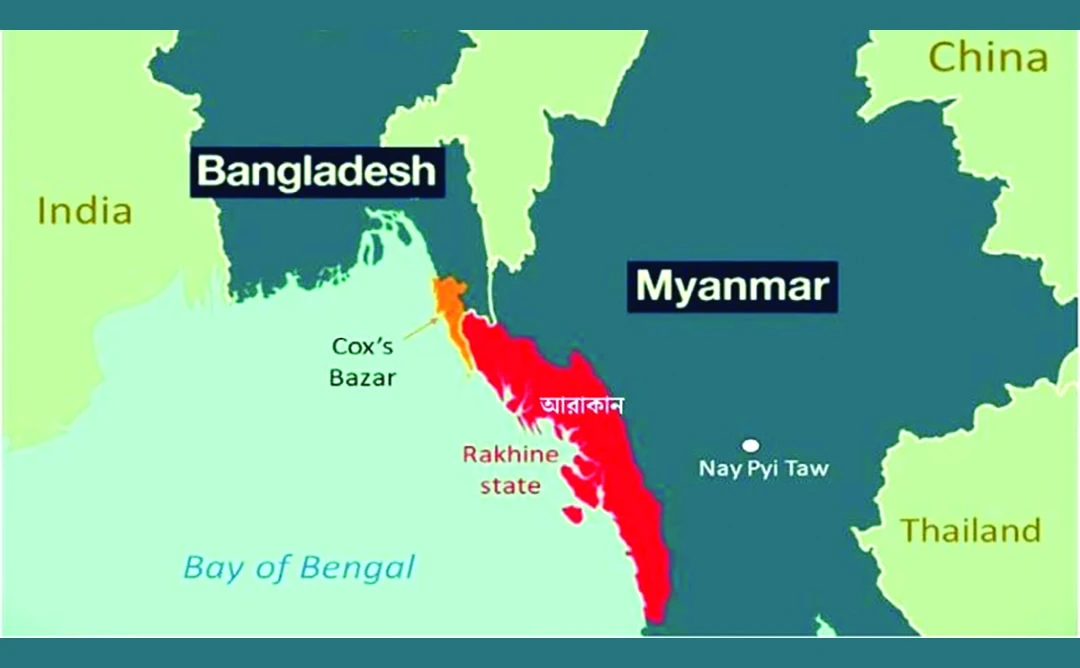
undergone dramatic changes in recent years. In Rakhine State, also known
historically as Arakan, the United League of Arakan (ULA) and its military
wing, the Arakan Army (AA), have emerged as influential actors controlling
significant territory and shaping local realities.
For Bangladesh, this development has important implications.
The eastern frontier can no longer be viewed solely through the lens of
state-to-state diplomacy. Border management, humanitarian concerns, security
cooperation and future stability increasingly depend on developments within
Arakan itself.
Recognizing this reality is not a matter of political
preference; it is a matter of strategic understanding. Bangladesh must continue
to maintain formal relations with Myanmar through established diplomatic
channels. At the same time, policymakers must acknowledge that the situation
along the frontier is becoming more complex and requires a deeper understanding
of local dynamics.
The emergence of the Arakan factor has effectively
transformed Bangladesh’s eastern border from a conventional boundary-management
issue into a broader challenge involving security, humanitarian concerns and
regional geopolitics.
The FDMN Crisis and the Need for Realism
No issue demonstrates this transformation more clearly than
the humanitarian commitment shown by the government and people of Bangladesh,
which has earned international respect. Yet the prolonged nature of the crisis
has also imposed significant economic, environmental, and social costs.
The central question remains unchanged: what is the
realistic path forward?
Bangladesh cannot rely indefinitely on temporary
arrangements. History shows that prolonged displacement often becomes
increasingly difficult to reverse. What begins as a temporary humanitarian
response can gradually evolve into a long-term reality.
The only durable solution remains the safe, voluntary,
dignified and sustainable return of the FDMNs to Myanmar. However, achieving
this objective requires a realistic assessment of conditions inside Rakhine
State.
Repatriation will ultimately depend on security,
livelihoods, mobility, rights and social coexistence within the areas where the
FDMNs are expected to return. Those realities will be shaped on the ground in
Arakan, not merely through diplomatic statements issued from distant capitals.
This does not mean abandoning diplomatic efforts. Rather, it
means aligning policy with realities. Bangladesh’s FDMN strategy and its
understanding of developments in Arakan are increasingly interconnected. Any
meaningful progress toward repatriation will require a clear understanding of
the evolving situation inside Rakhine State.
Building a Comprehensive Bangladesh Strategy
Bangladesh now requires a broader and more sophisticated
approach to Myanmar—one that combines diplomacy, security and knowledge.
At the diplomatic level, Bangladesh must continue
constructive engagement with Myanmar while remaining attentive to changing
realities along the frontier. Effective diplomacy requires both adherence to
international norms and an accurate understanding of developments on the
ground.
At the security level, the eastern border presents growing
challenges. Narcotics trafficking, human trafficking, arms smuggling and other
forms of transnational crime threaten stability on both sides of the frontier.
Effective communication, confidence-building measures and crisis-management
mechanisms are therefore essential. Minor incidents involving fishermen,
refugees or border communities should never be allowed to escalate into larger
security concerns.
Equally important is the societal and intellectual
dimension. Bangladesh needs far greater investment in understanding Myanmar.
Our universities, think tanks, research institutions and professional academies
should encourage the study of Myanmar’s history, language, society, economy and
ethnic politics.
We have developed considerable expertise regarding many
regions of the world, yet comparatively little about a country that directly
affects our national interests. A nation cannot formulate effective policy
toward a neighbour it barely understands. Knowledge reduces uncertainty,
expands policy options and strengthens strategic decision-making.
From a Frontier of Crisis to a Frontier of Opportunity
The story of Bangladesh’s eastern frontier does not have to
be defined solely by conflict and crisis.
Arakan occupies a strategically important position on the Bay of Bengal and sits at the intersection of South and Southeast Asia. As regional connectivity, maritime trade and economic integration continue to expand, the significance of this region is likely to increase.

Naf River is the only river that is shared between Myanmar and Bangladesh.
A stable and prosperous Arakan could contribute to greater
connectivity, legal trade, economic cooperation and regional development. An
unstable Arakan, on the other hand, risks perpetuating refugee flows, criminal
activity and humanitarian crises that directly affect Bangladesh.
For this reason, Bangladesh has a legitimate interest in the
emergence of a peaceful, stable and inclusive Rakhine State. This is not a
question of interference in another country’s internal affairs. It is simply
recognition that developments across our border have direct consequences for
our own security and prosperity.
The first step toward effective policy is understanding. For
too long, Myanmar has remained one of the least understood countries in
Bangladesh’s strategic discourse. The emergence of the Arakan factor has made
that knowledge deficit increasingly costly.
Bangladesh has invested significant effort in understanding
many dimensions of its regional environment. The time has come to devote
similar attention to our eastern neighbour.
Demystifying Myanmar is no longer merely an academic
exercise. It is a strategic necessity for Bangladesh’s future.
আরও পড়ুন -