





Editor & Publisher: Rabb Majumder
House # 05 (2nd Floor, 2-C), Road# 04, Banani DOHS, Dhaka - 1206
Phone: +8801715822782
Phone (Advertisement): +8801712863234
Email: rabb.h.majumder@gmail.com, info@securityworldbd.com

Securing Critical Undersea Infrastructure in the Bay of Bengal
Dependence, Exposure and Regional Resilience from a Bangladesh Perspective
Admiral Aurangzeb Chowdhury (Retd)
19:28, 19 November, 2026
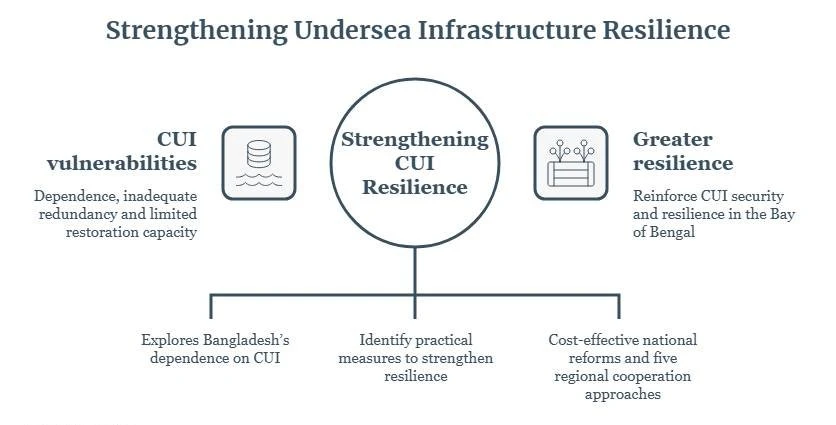
Critical undersea infrastructure (CUI), especially Submarine
cables and offshore energy facilities are crucial to global connectivity and
energy security. Increasing dependence on such critical infrastructure in the
Bay exposes Bangladesh to great risks due to disruption, inadequate redundancy
and limited restoration capacity. This study
explores Bangladesh’s dependence on CUI, its weaknesses, restoration capacitiesvis-à-vis
existing governance organizations to identify practical measures to strengthen
resilience. This paper delved into scholarly literature, policy documents,
legislation, official records, industry data and media reports and adopted a
qualitative single-case study approach. The findings found that international
submarine connectivity of Bangladesh relies exclusively on two state-owned
cables with a capacity of approximately 7.2 Tbps, against national demand of
around 13.5 Tbps, while approximately 29% of its gas supply depends on two
offshore floating terminals. The SEA-ME-WE 5 cable disruption of prolong 69
days duration in 2024 highlighted critical vulnerabilities, specifically dependence
on foreign repair-vessels and associated regulatory authorizations. Fragmented
national governance and insufficient regional cooperation further weaken
resilience. This paper argues that concentration of infrastructure and late
restoration pose greater risks than intentional assaults alone. The study suggests
cost-effective national reforms and five regional cooperation approaches, using
present institutional frameworks, to reinforce CUI security and resilience in
the Bay of Bengal.
Keywords: Critical Undersea Infrastructure;
Bangladesh; Bay of Bengal; Submarine Cables; Maritime Security; Infrastructure
Resilience; Regional Cooperation.
1. Introduction
1.1 What Undersea Infrastructure
is, and Why it Matters
Critical
undersea infrastructure includes set of installations on or underneath the sea
bottom,the disruption of which would adversely affect the economy, security or
public services of the state. It comprises four different categories (Table 1).
The submarine fibre-optic telecommunications cables, which are most significant
carry the internet, financial messaging, cloud services and much government
traffic between countries [1,2]. The modern cables are mostly about the width
of a garden hose. The glass fibres are located at its core with the thickness
of a human hair, protected by a copper conductor that powers the steel strength
members, repeaters and a polyethylene sheath having extra armour in shallow
water [1,2]. Repeaters amplify the light pulses travelling along the fibres at
intervals along the route, and branching units permit one trunk to serve several
nations (Figure 1). A landing station, where the cable touches shore connects
it to the national network; it is frequently the most visible spot in the
system [3].

Figure
1. Key sections of critical undersea infrastructure, from the landing station
to the deep-sea bottom, with a simplified cable cross-section. Schematic, not
to scale. Sources: compiled by the author from Carter et al. [1], Tele Geography
[2] and ENISA [3].
Table 1. Main Types
of Critical Undersea Infrastructure
|
Type |
Function |
Examples
relevant to Bangladesh |
|
Telecommunications
cables and landing stations |
International
data, voice and internet traffic |
SEA-ME-WE 4
(Cox’s Bazar), SEA-ME-WE 5 (Kuakata), SEA-ME-WE 6 (planned) |
|
Energy
pipelines and moorings |
Import or
transport of oil and gas |
Single point
mooring and undersea pipeline off Moheshkhali (since 2023) |
|
Floating
terminals and their subsea connections |
LNG
regasification and delivery to shore |
Two FSRUs off
Moheshkhali |
|
Power cables
and other seabed assets |
Electricity
interconnection, offshore energy, ocean sensing |
None in
service; potential future offshore energy and research assets |
Sources:
author’s classification, drawing on Carter et al. [1] and ENISA [3];
Bangladesh examples from the sources cited in Section 2.
The magnitude of dependency
on submarine cables globally is enormous and is on the rise. As per TeleGeography
there are more than 600 active and planned cable systems and over 1.5 million
kilometres of cable in service [2]; the Internet Society tracks about 570
cables in service in 2025, with 81 more planned, carrying 97–98% of
intercontinental internet traffic [4]. Satellites cannot be a scalable
alternative. The regulator in the US places their portion of US international
capacity at 0.37% [2]. Cables fail quite frequently, at a rate of about 150 to
200 faults a year globally attributable commonly to fishing gear and ships’
anchors [2,3]. The presence of a cable is felt instantly by the entire economy
only when it fails [5,6].
1.2 The Bay of Bengal as a Corridor
and a Commons
The
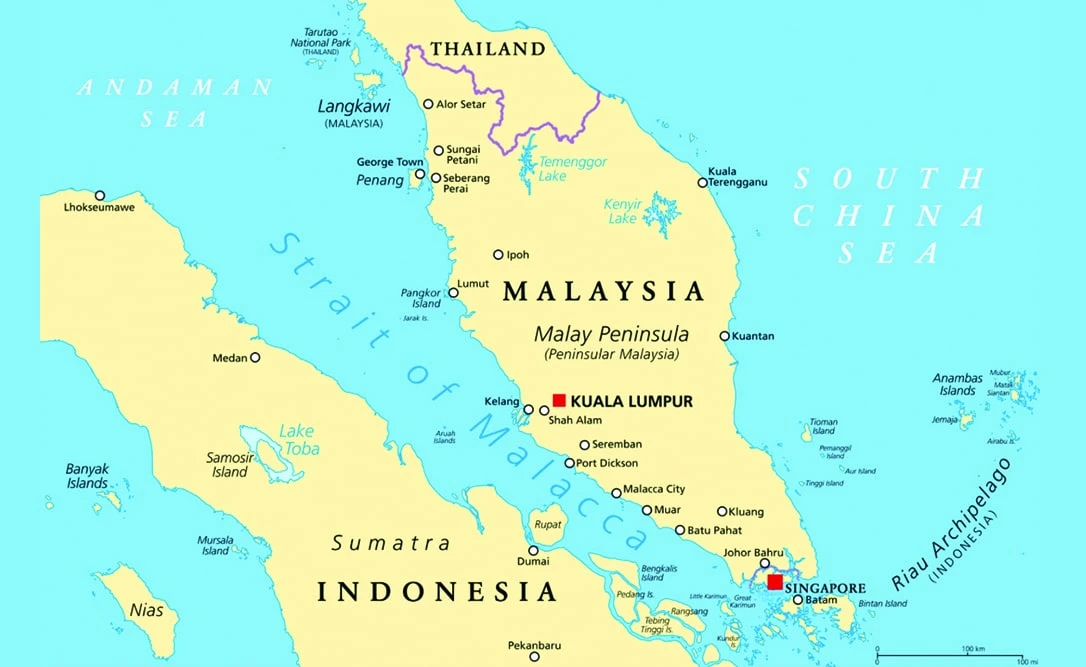
Bay of Bengal forms a bridge between South and South-East Asia and lies on the mouth
of the Strait of Malacca, through which 25% of the world’s maritime commerce crosses
[7]. It is a “strategic hinge” between the Indian Ocean and the Pacific [8].
What lies hidden underneath these waters matter just as much. The SEA-ME-WE
(South-East Asia–Middle East–Western Europe) cable systems that provides vital service
to Bangladesh, India and Sri Lanka pass through the Strait of Malacca to
Singapore. Sri Lanka has turned into a cable hub, with the landing of
India–Asia–Xpress at Matara in 2023 and SEA-ME-WE 6 landing there in December
2024 [9,10]. India connected Chennai with the Andaman and Nicobar Islands in
2020 by a 2,313 km cable [11,12]. The locations and the major systems that are
discussed in this article are shown in figure 2.

Figure
2. The principal submarine infrastructure in the Bay of Bengal discussed in
this article. Cable routes are indicative only. Base map: Natural Earth (public
domain). Landing and event data: sources cited in Sections 1.2 and 2.
The Bay of Bengal
presents a challenging physical environment. The Bay represents some of the most
engaged coastal fishing grounds in Asia, congested and overcrowded anchorages
off Chattogram, Mongla and Payra, an annual tropical storm season, and the
Swatch of No Ground, a deep submarine canyon located at the edge of
Bangladesh’s shelf that feeds sediment flows into the Bengal Fan [13,14].
Bangladesh has settled its maritime boundaries through international adjudication
with Myanmar in 2012 and India in 2014 [15,16].
1.3 Problem, Aim and Research Questions
Since
2023, a series of incidents from the Baltic to the Taiwan Strait and off
Western Australia, has shifted the submarine infrastructure from a purely
technical subject to a matter of national security issue [17,18]. Though there
is no confirmed intentional attack in the Bay of Bengal yet, its littoral
states is dependent on a small number of foreign ships for repair of their systems.
The Sixth Bay of Bengal Maritime Dialogue (Colombo, 3–4 November 2026) earmarked
a session dealing with the subject and asked participants to identify emerging
norms, critical information gaps, lessons from other regions and concrete
measures [7].
This article attempts
to address those questions from the perspective of Bangladesh. The aim is to
assess the resilience of the submarine infrastructure which is vital for
Bangladesh and propose practical measures.
There are four research
questions:
•
RQ1. How dependent is Bangladesh on submarine
infrastructure in the Bay?
•
RQ2. How vulnerable is that
infrastructure to accidental, natural and deliberate harm?
•
RQ3. How quickly can it be restored when
it fails, and what are the limitations?
•
RQ4. How well prepared are national,
regional and international governance arrangements to provide security, and
what should change?
2. Key Findings and Strategic
Analysis
2.1 Dependence: A Large Economy
on Two Cables
Bangladesh’s
international connectivity has been developed in three stages of the SEA-ME-WE
system, all owned and operated by the state-owned Bangladesh Submarine Cable PLC
(BSCPLC) (Table 2). SEA-ME-WE 4 landed at Cox’s Bazar in 2006 and SEA-ME-WE 5
at Kuakata in 2017. In September 2026 BSCPLC reported total capacity of about
7,200 Gbps, of which about 4,000 Gbps was in use [36]. Experts cited by Financial
Express put the capacity of the two systems at about 4.6 Tbps and 2.5 Tbps
respectively and expect SEA-ME-WE 4 to reach the end of its operational life
around 2030 [37].
Table 2.
Undersea Infrastructure on Which Bangladesh Depends
|
Asset |
Landing or
location |
In service |
Role and
status |
|
SEA-ME-WE 4 |
Cox’s Bazar |
2006 |
About 4.6 Tbps; end of design life
expected around 2030 |
|
SEA-ME-WE 5 |
Kuakata |
2017 |
About 2.5 Tbps; out of service 20
April–28 June 2024 |
|
SEA-ME-WE 6 |
Cox’s Bazar (planned) |
Expected 2027 |
Would raise state capacity to about
34 Tbps |
|
Bangladesh Private Cable System
(BPCS) |
Planned |
Stalled |
Design 3 fibre pairs of at least 15
Tbps; vessel clearance withheld in August 2026 |
|
Single point mooring and twin
pipelines |
Off Moheshkhali |
July 2023 |
Crude oil and diesel imports to
Chattogram |
|
Two FSRUs and subsea gas
connections |
Off Moheshkhali |
Since 2018 |
All imported LNG; about 29% of gas
supply in FY2024–25 |
Sources:
[14,36–40]. FSRU, floating storage and regasification unit. The FSRU share is
the author’s calculation from the figures in [14].
Growth in demand
has significantly outpaced our existing submarine cable infrastructure.
National bandwidth use rose from about 50 Gbps in 2013 to about 13.5 Tbps in
2026 [37], and Bangladesh had 135.95 million internet subscriptions at the end
of June 2026 [41]. International Terrestrial Cable (ITC) operators importing
bandwidth over land from India fills the gap between the 7.2 Tbps of submarine
capacity and the 13.5 Tbps used. About 60% of Bangladesh’s bandwidth was being
received this way, but in February 2025, the regulator limited Indian imports
at 50% [42]. BSCPLC doubts that a crisis is imminent, pointing to unused
capacity and to SEA-ME-WE 6 [36]. The independent forecasts, however, are quite
high: about 19.1 Tbps in 2027, 27 Tbps in 2028 and 54 Tbps in 2030 [37]. The
regulator’s own projection of about 30 Tbps by 2030 [36] is lower, but still
close to the 34 Tbps that state capacity would reach with SEA-ME-WE 6 (Figure
4).

Figure
3. Bangladesh’s international bandwidth: current supply and projected demand.
State capacity and use from BSCPLC; national use and projections from experts
quoted by Financial Express; regulator projection from
BSCPLC. Sources: [36,37].
This becomes
clearer with two additional facts. The third cable has stumbled: reports in
2025 expected SEA-ME-WE 6 to reach Bangladesh by the end of 2026 [43], but
BSCPLC now expects it in 2027 [36]. Private sector led diversification has not
yet been achieved. Bangladesh Private Cable System (BPCS), designed as three
fibre pairs of at least 15 Tbps each, submitted application for vessel
clearance on 31 March 2026 [38]; clearance was suspended in August, after about
US$53 million had been spent [39]. It’s important to note that the cable can be
laid only during the November to mid-May weather window [44]. The government
announced in September 2026 that it would open the submarine cable market to
private investors [45]. Regionally, Bangladesh is an outlier: experts count 19
international cables landing in India, 23 in Malaysia, 19 in the Philippines, 12
in Thailand and 10 in Sri Lanka, against barely two in Bangladesh [37].
The energy sector
is also subject to this dependence. The single point mooring off Moheshkhali,
Bangladesh’s first undersea pipeline, entered service in July 2023 [40]. All
imported LNG arrives in Bangladesh through two Floating Storage and Regasification
Units (FSRUs) moored in the same area. In FY2024–25 the country imported 7.98
billion cubic metres of LNG against domestic production of 19.6 billion cubic
metres [14], so the two FSRUs supplied about 29% of total gas (author’s
calculation). A recent studydepicts these installations and the associated
pipelines as “a major point of vulnerability” and predicts LNG’s share to grow
towards half of supply by 2028 [27].
It is worth noting
that the data demonstrates three distinct forms of concentration. The first is
physical: two cables and two landing stations handle the total volume of
Bangladesh’s submarine traffic, and two floating terminals in one anchorage
carry entirequantity of its LNG. The second is institutional: one state-owned
company owns all submarine capacity. The third is geographic: the balance of
internet traffic arrives through a single neighbour. The Indian links are a
real asset, as April 2024 showed, but they are a substitute route rather than
additional undersea resilience.
2.2 Exposure: Ordinary Hazards, Rising
Strategic Attention
Accidental
and Natural Causes. Human activity triggers most of the faults at sea worldwide
and not by sabotage. Compiled data by European Union Agency for Cyber security
(ENISA)from International Cable Protection Committee (ICPC)indicates that approximately
40% of all faults in a recent dataset originated from anchoring and fishing
alone, and 87% are reported due to all kinds of human intervention. (Figure 4)
[3]. TeleGeography features that about two-thirds of faults are due to fishing
and anchoring alone [2], and the International Telecommunication Union (ITU)places
the figure at about 80% [46]. The differences reflect datasets and the share of
faults with no recorded cause; the direction is the same in all three.

Figure 4. Causes
of submarine cable faults, as a share of recorded faults. Data: ENISA analysis
of ICPC fault data, 2023; “other human” derived by the author as the difference
between total human intervention and anchoring and fishing. Source: [3].
The Bay faces
challenging conditions due to these hazards regularly. Its coastal waters are
overcrowded with small-boat fishing, and its approaches to Chattogram, Mongla
and Payra are congested with ships at anchor [27]. Tropical storms strike the
energy terminals directly: during Cyclone Mocha in May 2023 both FSRUs got
disconnected, and after Cyclone Remal in May 2024 regasification got reduced
from about 1,100 to about 600 million cubic feet a day for almost four months
[14]. Due to a technical glitch that occurred in July 2026about 450 million
cubic feet a day were removed, roughly half of LNG supply [14]. The Canyon
Channels in the Swatch of No Ground transports sediment into the Bengal Fan
[13]. Although no cable failure is attributed to it so far, the turbidity
currents that broke multiple cables off Taiwan and elsewhere [1] make it a
point worthtaking into cognizance when routing future cables.
Deliberate Interference.
There has been no confirmed report of any deliberate attack on undersea
infrastructure in the Bay of Bengal yet. The international situation has,
however, experienced abrupt change (Figure 5). Since 2023, cables have been severed
near Taiwan’s Matsu islands [47], in the Red Sea by the anchor of a damaged
ship [48], and in the Baltic, where the tanker Eagle S damaged the Estlink 2
power cable and four telecommunications cables on 25 December 2024 [23]. This
has affected Bangladesh directly: SEA-ME-WE 4 was among the cables severed in
the Red Sea in September 2025 [49]. In 2026 two cables failed off Perth inside
a cable protection zone, with an unidentified vessel recorded nearby and an
assessment by the Australian Federal Police that reached no conclusion [50,51];
the Australia–Singapore Cable was cut inside Indonesian waters in September
[52]; and the City-to-City (C2C) system between the Philippines and Singapore
failed in early October, the cause undetermined [53].

Figure
5. Selected incidents affecting undersea infrastructure, 2023–2026. Events that
affected Bangladesh directly are in bold. Sources: [14,23,24,35,47–50,52,53].
Geopolitical and
strategic interests in the seabed of the Bay continue to expand. There are
reports that Chinese research and survey vessels are operating in and near the
Bay, including near the Investigator Ridge [8], and a Chinese research vessel
was reported to have sailed for 16 days in July 2025 with its Automatic Identification
System (AIS) switched off [54]. There are indications that fibre links to
island bases could also carry undersea sensors, although this remains
speculative [26]. Survey activity is lawful in many circumstances, and none of
these reports shows hostile intent; but survey data on bathymetry and seabed
conditions are dual-use, and they reveal where cables lie.
However, for
Bangladesh the likelihood of damage would be predominantly by the ordinary:
fishing gear, anchors, tropical storms and faults on distant parts of systems
it does not have control over. Both cable disruptions that Bangladesh has faced
since 2023 happened at a far distance from the Bay, in the Strait of Malacca
and the Red Sea. The deliberate threat is real but, in current evidence, a
question of preparedness rather than of an observed pattern in the Bay.
2.3 Recovery Capacity: the April
2024 Case
The obvious
proof about Bangladesh’s resilience arises from the failure of SEA-ME-WE 5 in
2024. A fault occurred on 20thof April in Indonesian waters of the
Strait of Malacca, which is about 440 km from Singapore, and consequently Bangladesh
lost about 1.7 Tbps, approximately a third of its international bandwidth at
the time [35]. As per the initial estimation of BSCPLC’sthe repairs would take
“a minimum of two to three days” [35]. The service was however restored on 28th
of June, 69days later [55]. The main reason was not technical. The delay was
principally attributable to Indonesian cabotage rules that required the deployment
of a locally flagged repair vessel and permits [56]. The cause of the fault was
never publicly confirmed and nobody attacked that cable [57].
The outage did not lead
to a full-blown national shutdown. Internet Society calculations indicated that
much of the traffic was absorbed by Indian terrestrial links and about 69% of
the most popular websites were served from caches inside Bangladesh [34]. These
are valuable lessons learnt: terrestrial links and local content were found to
be the most effective forms of resilience available.
The 2024 case reveals
a structural limitation rather than a single catastrophe. As per the assessment
of ENISA there exist only about 30 cable maintenance vessels and 35
installation vessels globally, and accounts for 185 repairs across 44
jurisdictions in 2021 [3]. None is based in Bangladesh, and we are not alone.
India, the largest user of this Bay, has no Indian-flagged cable repair ship.
Its repair depends on vessels based in Singapore and Dubai. Repairs in Indian
waters usually take four to five months; India plans a single window permit
portal by March 2027 [58]. The Australia–Singapore Cable repair in 2026 was
again slowed due to permits, cabotage rules and approvals from navy [52]. The
conclusion arrived at the International Cable Protection Committee-Centre for
International Law (ICPC–CIL) workshop suggests that governments should assign a
single point of contact for cable related issues and pre-authorise repair
components so that repair activities are not delayed pending necessary permission
[30].
In each recent case
the duration of an outage was less attributable to the damage than to permits
and decisions, flags and the availability of cable repair ships. Repair is the
region’s weak link. For Bangladesh, whose submarine cables cross several territories
before they reach Singapore, recovery depends on the rules of states it does
not have any control over. This is the central finding of the study.
2.4
Governance: National Arrangements
Law.
Territorial Waters and Maritime Zones Act of Bangladesh was updated in 2021andcomprises
communication cables and oil pipelines among protected “installations” and sets
penalties of minimum three years’ imprisonment and fines ranging from Tk 5 to10
crore [59]. Its section on cables, however, follows United Nations Convention
on the Law of the Sea (UNCLOS) Article 113 referring cables “beneath the High
Seas” [22,59]. Whether it reaches damage by a foreign ship within Bangladesh’s
territorial sea or exclusive economic zone is not specified. The Finnish Eagle
S case demonstrates why is this important: a district court dismissed the case
for lack of jurisdiction in October 2025, and an appeal court reversed that
decision in August 2026 [23,60]. Taiwan, conversely, sentenced the captain of
the Hong Tai 58 under domestic law in June 2025 [24]. The older 1884 Convention
for the Protection of Submarine Telegraph Cables lacks broad ratification and proposes
little additional cover [30,61]. The Cyber Security Ordinance of 2025 deals
with fibre-optic networks but not the undersea physical terrain [62]. The Coast
Guard Act of 2016 entitles coastal law enforcement its powers. Our Indo-Pacific
Outlook, announced in April 2023, commits Bangladesh to the Law of Sea
Convention, to freedom of navigation and overflight, and to strengthening existing
mechanisms for maritime safety and security. Protection of submarine cables falls
squarely within those commitments.
Institutions.Division
of responsibility. The Ministry of Posts Telecommunications and Information
Technology and the regulator responsible for issuing license and regulatingsubmarine
cables; BSCPLC owns and maintains them; the Navy and the Coast Guard, under the
Coast Guard Act 2016, police the sea [27,63].The Australian National University
(ANU) studyfound no central body to coordinate maritime domain awareness, no unified
and comprehensive national oceans policy or a formal standalone maritime
security strategy, and no coastal radar coverage outside Chattogram region, and
a Coast Guard that is under-resourced compared to the task it is expected to
perform [27]. Under Operation Blue Guard the Navy keeps a ship and a contingent
deployed continuously, escorts LNG carriers and supports cable laying, and cable
security as part of its responsibility [27]. From March 2026, the Navy in
coordination with the Coast Guard increased patrols to protect fuel vessels,
the ports, energy installations and undersea infrastructures [64]. The head of Bangladesh
Institute of Maritime Research and Development (BIMRAD), a maritime research institute,
has proposed a National Maritime Security Council to bring all the fragmented
institutions and agencies under one umbrella for better coordination [28].
Some recent steps have
strengthened the capability of the foundations. Bangladesh agreed to acquire
the former Royal Navy survey vessel HMS Enterprise in February 2026 [65], which
will improve hydrographic capacity, and it chairs the North Indian Ocean
Hydrographic Commission for 2025–2027 [66]. Bangladesh’s Indo-Pacific Outlook
of 2023 commits it to maritime cooperation but not specific regarding undersea
infrastructure, although those commitments encompass submarine cable protection
[67].
Table 3 Summarizes the national gaps.
Table 3. National Governance
of Undersea Infrastructure in Bangladesh: Provisions and Gaps
|
Function |
Current provision |
Gap identified |
|
Legal protection |
Maritime Zones Act 2021; penalties of at
least 3 years and Tk 5–10 crore |
Reach over foreign ships in territorial sea
and EEZ not explicit; no cable protection zones |
|
Strategy and coordination |
Indo-Pacific Outlook 2023; proposed
National Maritime Security Council |
No maritime security strategy; no lead body
for undersea infrastructure |
|
Maritime domain awareness |
Navy (Operation Blue Guard) and Coast
Guard; radar around Chattogram |
No central fusion of the maritime picture;
limited coverage beyond Chattogram |
|
Charting and data |
Navy hydrographic service; survey vessel
acquired 2026 |
Cable and pipeline routes not consistently
shown on charts available to fishers |
|
Repair and permits |
Ad hoc clearances |
No single point of contact; no pre-agreed
regime for foreign repair ships |
|
Operator–state relationship |
BSCPLC (state-owned); regulator |
No routine fault-data sharing with the Navy
and Coast Guard |
Sources:
[27,28,30,59,63–65,67]. The charting and data-sharing gaps are the author’s
assessment from these sources.
2.5 Governance: Regional and International
Frameworks
The
Bay has more instruments and building blocks than is generally presumed, but
none yet deal with undersea infrastructure directly (Table 4). In July 2026,Bay
of Bengal Initiative for Multi-Sectoral Technical and Economic Cooperation
(BIMSTEC) security chiefs, meeting in New Delhi, endorsed guiding principles on
the conduct of maritime law enforcement agencies at sea and guidelines for
humanitarian assistance and disaster relief [68]; BIMSTEC’s agreement on
maritime transport cooperation entered into force in May 2026 [69]. The Colombo
Security Conclave (CSC), which Bangladesh joined as a full member on 20
November 2025, has a pillar on cybersecurity and the protection of critical
infrastructure [70]. The Information Fusion Centre – Indian Ocean Region in
Gurugram hosts liaison officers from partner states [71]. The North Indian
Ocean Hydrographic Commission brings together the Bay’s littoral states [66].
The outcome of the Fifth Bay of Bengal Maritime Dialogue named undersea
infrastructure an emerging threat [72]; and the report on specific outcome on
the issueis yet to come from the recently concluded Sixth Dialogue [73].
Table 4.
Selected Frameworks Relevant to Undersea Infrastructure in the Bay of Bengal
|
Framework |
Level |
Relevant Content |
Status for
Bangladesh |
|
UNCLOS Articles 79, 112–115 |
Global |
Freedom to lay cables; duty to
criminalise damage; indemnity rules |
Party; implemented in the 2021 Act |
|
ITU–ICPC International Advisory
Body for Submarine Cable Resilience |
Global |
Summits (Abuja 2025, Porto 2026);
recommendations on repair and permits (2026) |
Open to participation |
|
New York Joint Statement on
undersea cables (2024) |
Plurilateral |
Security and resilience principles |
Not an endorser |
|
ASEAN Guidelines on cable
resilience (2019, enhanced 2026) |
Regional |
Single contact point; streamlined
repair permits |
Not a member; Myanmar and Thailand
are |
|
BIMSTEC maritime law enforcement
principles (2026) |
Bay of Bengal |
Conduct of agencies at sea |
Chair 2025-2027; no CUI content yet |
|
Colombo Security Conclave |
Indian Ocean |
Critical infrastructure pillar |
Member since 2025 |
|
Information Fusion Centre – IOR |
Indian Ocean |
Shared maritime picture |
Partner arrangements possible |
|
North Indian Ocean Hydrographic
Commission |
Bay of Bengal |
Charting standards and cooperation |
Chair 2025–2027 |
|
EU Cable Security Toolbox (2026) |
Other region |
Repair capacity; streamlined
permits including territorial sea and EEZ |
Model only |
Sources:
[22,31,66,68,70,71,74–77].
Association of
South-East Asian Nations (ASEAN) is progressing fast and in2019 approved the
guidelines on cable resilience and augmented them in January 2026 to call for a
single government contact point and streamlined permits to affect repair [77]. In
2024, the ITU and ICPC formed an International Advisory Body for Submarine
Cable Resilience; it organized summits in Abuja and Porto in February 2025 and
February 2026 respectively [74] followed by announcement of working-group
recommendations in July 2026 [75]. In February 2025, the European Union (EU)approved
an Action Plan on Cable Security [78], followed by setting up of a Submarine Cable
Security Toolbox in January 2026 that prioritises strengthening repair
capabilities and streamlining permitting procedures, including access to
territorial waters and exclusive economic zones to conduct operations to carry
out cable repair[31]. In January 2025,North Atlantic Treaty Organization (NATO)
commenced Operation Baltic Sentry, a multi-domain security mission [79]. In May
2023, the Quad launched the Quad Partnership for Cable Connectivity and
Resilience [80]. The EU together with 16 other countries endorsed the New York
Joint Statement in September 2024; Bangladesh, India and Sri Lanka did not
[76]. The ICPC–CILworkshop observed that Asia has no regional cable protection
committee [30].
2.6 Summary
of Results
Table 5 brings the four
dimensions together. The ratings are the author’s qualitative judgement from
the evidence above.
Table 5. Resilience Scorecard for Undersea
Infrastructure Serving Bangladesh
|
Dimension |
Rating |
Principal evidence |
|
Dependence |
High (unfavourable) |
Two state cables (7.2 Tbps) against
13.5 Tbps use; one landing site per cable; about 29% of gas through two FSRUs |
|
Exposure |
Moderate to high |
Fishing, anchoring and cyclones;
distant faults in Malacca and the Red Sea; rising survey activity; no
confirmed attack in the Bay |
|
Recovery capacity |
Low |
69-day outage in 2024; no regional
repair ship; permits and cabotage dominate repair times |
|
Governance |
Low to moderate |
Fragmented mandates; no lead body or
strategy; legal reach unclear; regional bodies exist but lack CUI content |
3. Systemic Risks and Governance Implications
3.1 Concentration, not Sabotage
as the Primary Threat
Since
2022, literature has framed undersea infrastructure focusing mainly on hybrid
threats and sabotage [17,18]. For a developing littoral state such as
Bangladesh, this perspective addresses only one dimension of the broader risk landscape.
Since 2023, every disruption that Bangladesh experienced originated from either
an ordinary cause or an unknown one: a fault in the Malacca Strait, cuts in the
Red Sea, and tropical storm damage to energy terminals. The fundamental factor
that turned these incidents into national-level challenges was the
concentration of critical infrastructure, marked by a limited number of cables,
landing points, terminals and repair vessels.
This
reinforces Liebetrau and Bueger’s argument that resilience, rather than
protection alone, should serve as the guiding principle for policy [5], while
aligning with ENISA’s emphasis on redundancy and repair capabilities [3].The
policy implication is that Bangladesh’s most effective security investments are
also those that strengthen its economic resilience. These include bringing third
submarine cable into service, encouraging private and regional cable systems to
install future landing sites away from the Cox’s Bazar-Moheshkhali cluster, and
diversifying energy import facilities. Physical security remains equally
important, as effective deterrence against interference requires the state to
maintain adequate surveillance and awareness of its seabed. However, naval policing
alone cannot address the vulnerabilities of an infrastructure network dependent
on just two critical points of failure.
3.2 The
Imperative of Repair Sovereignty
The outage that
lasted 69days in 2024 underscores the significance of what may be labeled
repair sovereignty - a state’s capability to ensure timely repair of its
critical infrastructure without excessive dependence on the decisions or
discretion of other states. Bangladesh’s submarine cables pass through the
waters of many countries, implying that, in case of a failure, the pace of
repair is often subject to the respective coastal states’ regulations
concerning vessel flagging, permits and naval clearances, rather than
Bangladesh’s operational requirements. This should not be viewed as criticism
of Indonesia or any other state, as cabotage regulations serve legitimate
national interests. Rather, it reflects a challenge of cross-border
coordination that can be addressed through appropriate institutional
mechanisms. ASEAN’s enhanced guidelines endorsed in January 2026 [77], the EU’sSubmarine
Cable Security Toolbox [31] and the ICPC–CIL recommendations [30] broadly
converge on three practical measures: establishing a single point of contact,
introducing pre-approved repair protocols, and permitting emergency exemptions
from cabotage requirements. With Myanmar and Thailand being members of ASEAN, a
Bay of Bengal framework aligned with established ASEAN practices could build
upon an existing regional model rather than inventing an entirely new
mechanism.
3.3 Fragmentation and the Information
Deficit
The
second major structural vulnerability concerns information management and
sharing. Data on cable faults are maintained by private operators, maritime
activities are monitored by navies and coast guards, while seabed information
is held by hydrographic authorities. However, these sources of information are
seldom integrated. The absence of shared fault data makes it difficult to
distinguish accidental damage from deliberate interference, as demonstrated by
the Perth and C2C submarine cable incidents in 2026 [50,53]. Similarly, without
properly charted cable routes, fishing communities cannot take adequate
precautions to avoid damaging cables, while coast guards lack the necessary
information to identify suspicious activities in their vicinity. In Bangladesh,
a study conducted by the ANU found that no single agency consolidates the
overall maritime picture [27]and available information is even not being
utilised to its full potential. Nevertheless, information sharing offers a
promising area for regional cooperation, as existing mechanisms such as the
Colombo Security Conclave and the Information Fusion Centre provide an
institutional foundation on which further collaboration can be developed
[70,71].
3.4 Geopolitical Friction and the
Case for Neutral Mechanisms
The
Bay of Bengal is a domain of strategic rivalry [8,26]. Bangladesh’s interest is
to secure its infrastructure without being drawn into competing blocs. It did
not endorse the New York Joint Statement [76], and it engages itself in
mechanisms supported by broader membership of the United Nations. This implies
that the most appropriate arrangements for Bangladesh, and possibly for several
of its neighbours, are those that are functional, inclusive and anchored in
existing regional bodies, rather than those associated with any one power or
endorsed by select group of nations. Bangladesh’s own record supports such an
approach: it settled both of its maritime boundaries through international
adjudication [15,16], demonstrating a preference for rules-based results that
can function as a foundation for practical cooperation on the seabed.
3.5
Comparative Lessons from Other Regions
Three
valuable lessons arise from these comparative experiences. First, while the
establishment of protection zones is essential, it cannot ensure the security
of undersea infrastructure on its own. The cable faults recorded off Perth in
2026 occurred within an existing protection zone [50], highlighting the need to
complement such zones with effective surveillance, monitoring and enforcement
mechanisms. Second, domestic legal frameworks must clearly define the
jurisdiction and legal authority of coastal states over foreign vessels
operating within their maritime zones. The Finnish courts took nearly two years
to resolve the jurisdictional questions arising from the Eagle S case [60],
while Taiwan was able to pursue prosecution under a clearly established
domestic legal framework [24]. Third, cooperation to facilitate the timely
repair of damaged cables offers one of the most immediate and cost-effective
approaches to strengthening infrastructure resilience. This is reflected in the
emphasis placed on repair arrangements and operational coordination by both the
EU Submarine Cable Security Toolbox and ASEAN guidelines [31,77]. Finally, the
Baltic experience underscores the limitations of relying solely on naval
responses. Although Operation Baltic Sentry strengthened maritime surveillance
[79], it did not, in itself, address the underlying legal uncertainties exposed
by the Eagle S case.
4. Recommendations
The recommendations are drawn from the study’s findings and
designed to be practical and achievable. They are dependent on present
institutional frameworks, require no new treaty arrangements and involve
relatively modest costs. Organised into distinct layers (Figure 6), they are
summarised in Table 6, alongside the proposed lead institutions and
implementation timeframes.

Figure 6. Layered framework of recommended measures, from the
international to the national level. Source: Author.
National Measures
(Bangladesh)
1.
Designate a lead and a strategy.
Establish the National Maritime Security Council that BIMRAD has proposed [28],
with an explicit mandate for undersea infrastructure, and publish a maritime
security strategy that includes it.
2.
Build one maritime picture. Link the
Navy, the Coast Guard, the regulator and BSCPLC through a single maritime
domain awareness arrangement, so that cable faults, AIS data and patrol reports
are seen together [27].
3.
Clarify the law. Review the Maritime
Zones Act 2021 so that offences against cables and pipelines clearly apply to
foreign ships in the territorial sea and the exclusive economic zone, and
provide for declared protection zones off Cox’s Bazar, Kuakata and Moheshkhali,
with anchoring and trawling restrictions [25,30,59].
4.
Diversify routes and landings. Deliver
SEA-ME-WE 6 without further delay, resolve the clearance of private cables, and
encourage at least one new landing site away from existing ones [36,39,45].
5.
Harden energy terminals. Treat the
Moheshkhali FSRUs and pipelines as critical infrastructure, with dedicated
patrols, weather contingency plans and additional import capacity [14,27].
6.
Strengthen the Coast Guard. Expand its
offshore patrol capacity and coastal radar coverage beyond Chattogram covering
the whole coast [27].
Regional Measures
(Bay of Bengal)
7.
A 24/7 contact list. Within one year,
each Bay state names a single point of contact for cable incidents and repair
permits; BIMSTEC holds and tests the list [30,77].
8.
A green channel for repair. Accredited
repair ships enter on notification, with pre-agreed emergency exemptions from
cabotage rules, through an annex to the BIMSTEC maritime law enforcement
principles [31,68].
9.
A common fault notice. A standard format
for reporting faults and incidents, shared within hours through the Colombo
Security Conclave and the Information Fusion Centre [70,71].
10.
Charted cable corridors. Coordinated
through the North Indian Ocean Hydrographic Commission, with an awareness
program telling fishers where cables lie and that UNCLOS Article 115 entitles
them to compensation when they sacrifice gear to avoid damaging a cable
[22,66].
11.
A Bay of Bengal cable protection forum.
Governments, navies, coast guards, owners and repairers meet regularly, filling
the absence of a regional committee in Asia, with a first table-top exercise in
2027 [30].
International Engagement. Bangladesh should take part
actively in the ITU–ICPC Advisory Body [74,75] and align regional arrangements
with the ASEAN guidelines [77], so that the Bay’s practice is compatible with
its neighbors’.
Table 6.
Recommended Measures, Lead Bodies and Timeframes
|
No. |
Measure |
Lead |
Timeframe |
|
1 |
National Maritime
Security Council and strategy |
Government; Armed
Forces Division |
1–2 years |
|
2 |
One maritime
picture |
Navy, with Coast
Guard, regulator and BSCPLC |
1–2 years |
|
3 |
Legal review and
protection zones |
Ministries of
Law, Foreign Affairs and Posts and Telecommunications |
1–3 years |
|
4 |
Route and landing
diversity |
Posts and
Telecommunications Division; regulator; BSCPLC |
1–5 years |
|
5 |
Hardened energy
terminals |
Energy and
Mineral Resources Division; Navy |
1–3 years |
|
6 |
Coast Guard
capacity |
Ministry of Home
Affairs; Coast Guard |
2–5 years |
|
7 |
24/7 contact list |
BIMSTEC; all
member states |
Within 1 year |
|
8 |
Repair green
channel |
BIMSTEC; maritime
and telecom authorities |
1–3 years |
|
9 |
Common fault
notice |
Colombo Security
Conclave; IFC-IOR; operators |
1–2 years |
|
10 |
Charted corridors
and fisher awareness |
NIOHC; national
hydrographic offices; fisheries departments |
1–3 years |
|
11 |
Cable protection
forum and exercise |
Littoral states
with industry |
First exercise in
2027 |
Source:
Author. Lead bodies are indicative and subject to national decisions.
Progress
can be measured simply: whether the contact list exists and has been tested,
whether the first exercise has been held, and whether the first corridor has
been charted.
5. Conclusion
The digital economy and the increasing energy supply of Bangladeshdepend
heavily on a restricted inventory of submarine infrastructure assets extending
across the Bay of Bengaland its broader maritime boundaries. The findings of
this study suggest that the most significant threat to these assets, based on
currently available evidence, is not necessarily deliberate sabotage, but
rather the combination of infrastructure concentration and delays in repair.
This vulnerability is reflected in the country’s dependence on two submarine
cables, two energy terminals, and foreign vessels and regulatory approvals for
repair operations. The 69-day disruption in April 2024 demonstrated how an
otherwise routine technical failure can escalate into a national-level crisis
when such vulnerabilities coincide.
Addressing these challenges is both feasible and within
Bangladesh’s reach. At the national level, priorities should include
designating a lead agency for maritime security coordination, establishing an
integrated maritime domain awareness system, strengthening the relevant legal
framework, and accelerating the diversification of submarine cables and energy
terminals. At the regional level, practical cooperation could be advanced
through a designated contact network, expedited procedures for emergency repairs,
a common fault-notification mechanism, officially charted cable corridors, and
a dedicated forum for cable protection. These initiatives could be developed
through existing regional and institutional platforms, including BIMSTEC, the
Colombo Security Conclave, the Information Fusion Centre and the North Indian
Ocean Hydrographic Commission. Such measures would not necessarily require a
new treaty or substantial financial commitments. Rather, their success would
depend primarily on political commitment, clearly designated institutional
responsibilities and agreed implementation timelines. By pursuing these
measures collectively, the littoral states of the Bay of Bengal could translate
the protection of critical undersea infrastructure from policy aspiration into
effective regional practice.
References
1.
Carter L, Burnett D, Drew S, Marle G, Hagadorn
L, Bartlett-McNeil D, et al. Submarine cables and the oceans: connecting
the world. Cambridge (UK): UNEP World Conservation Monitoring Centre; Lymington
(UK): International Cable Protection Committee; 2009. 64 p. (UNEP-WCMC
Biodiversity Series No. 31). ISBN 978-0-9563387-2-3.
2.
TeleGeography. Submarine cable frequently asked
questions [Internet]. Washington (DC): TeleGeography; 2026 [cited 2026 Nov 9].
Available from:
https://www2.telegeography.com/submarine-cable-faqs-frequently-asked-questions
3.
European Union Agency for Cybersecurity (ENISA).
Subsea cables – what is at stake? Athens: ENISA; 2023 Jul. Available from:
https://www.enisa.europa.eu/publications/undersea-cables
4.
Internet Society. Policy brief: enhancing the
resilience of submarine Internet infrastructure [Internet]. Reston (VA):
Internet Society; 2025 Nov 13 [cited 2026 Nov 9]. Available from:
https://www.internetsociety.org/resources/policybriefs/2025/enhancing-the-resilience-of-submarine-internet-infrastructure/
5.
Liebetrau T, Bueger C. Protecting hidden
infrastructure: the security politics of the global submarine data cable
network. Contemp Secur Policy. 2021 [published online 2021 Mar 29].
doi:10.1080/13523260.2021.1907129
6.
Starosielski N. The undersea network. Durham
(NC): Duke University Press; 2015.
7.
Pathfinder Foundation; Centre for Humanitarian
Dialogue. Sixth Bay of Bengal Maritime Dialogue, 3–4 November 2026, Colombo:
concept note and agenda. Colombo: Pathfinder Foundation; 2026.
8.
Malik JM. China’s maritime and military strategy
in the Bay of Bengal and the Indian Ocean. Focus Asia: Perspective &
Analysis. Stockholm: Institute for Security and Development Policy; 2026 Aug
20. Available from: https://www.isdp.eu/wp-content/uploads/2026/08/Focus-Asia-Malik-Aug-20-2026-final.pdf
9.
Reliance Jio’s India-Asia-Xpress cable lands at
Matara, Sri Lanka. DCD (DatacenterDynamics). 2023 Apr.
10.
SLT-Mobitel completes historic SEA-ME-WE 6
submarine cable landing in Matara. Daily Mirror (Colombo). 2025 Jan 8.
11.
Undersea cable brings optical fiber to India’s
Andaman and Nicobar Islands. Light Reading. 2020 Aug 10.
12.
Basu P, Bose S, Basu Ray Chaudhury A. Andaman
and Nicobar Islands: facilitating India’s connectivity in the Bay of Bengal. J
Indian Ocean Reg. 2019 [published online 2019 Jul 23].
doi:10.1080/19480881.2019.1637553
13.
Swatch of No Ground. In: Wikipedia [Internet].
[cited 2026 Nov 9]. Available from:
https://en.wikipedia.org/wiki/Swatch_of_No_Ground
14.
FSRU fragility exposing gas supply
vulnerabilities. The Daily Star (Dhaka) [Internet]. 2026 Aug 6 [cited 2026 Nov
9]. Available from:
https://www.thedailystar.net/business/news/fsru-fragility-exposing-gas-supply-vulnerabilities-4241201
15.
International Tribunal for the Law of the Sea.
Dispute concerning delimitation of the maritime boundary between Bangladesh and
Myanmar in the Bay of Bengal (Bangladesh/Myanmar), Case No. 16, Judgment
of 14 March 2012.
16.
Permanent Court of Arbitration. Bay of Bengal
Maritime Boundary Arbitration (Bangladesh v. India), PCA Case No. 2010-16,
Award of 7 July 2014.
17.
Bueger C, Liebetrau T, Franken J. Security
threats to undersea communications cables and infrastructure – consequences for
the EU. Brussels: European Parliament, Subcommittee on Security and Defence;
2022. EXPO/IDA(2022)702557. Available from: https://www.europarl.europa.eu/thinktank/en/document/EXPO_IDA(2022)702557
18.
Guilfoyle D, Paige TP, McLaughlin R. The final
frontier of cyberspace: the seabed beyond national jurisdiction and the
protection of submarine cables. Int Comp Law Q. 2022;71(3):657–96.
doi:10.1017/S0020589322000227
19.
Sunak R. Undersea cables: indispensable,
insecure. London: Policy Exchange; 2017. Available from:
https://policyexchange.org.uk/wp-content/uploads/2017/11/Undersea-Cables.pdf
20.
Burnett DR, Beckman RC, Davenport TM, editors.
Submarine cables: the handbook of law and policy. Leiden: Martinus Nijhoff;
2014. ISBN 978-90-04-26032-0.
21.
Davenport T. Submarine cables, cybersecurity and
international law: an intersectional analysis. Cathol Univ J Law Technol.
2015;24(1):Article 4. Available from:
https://scholarship.law.edu/jlt/vol24/iss1/4
22.
United Nations Convention on the Law of the Sea.
Montego Bay, 10 December 1982. United Nations Treaty Series, vol. 1833,
p. 3.
23.
2024 Estlink 2 incident. In: Wikipedia
[Internet]. [cited 2026 Nov 9]. Available from:
https://en.wikipedia.org/wiki/2024_Estlink_2_incident
24.
Ship’s captain from China jailed for three years
in Taiwan over subsea cable sabotage. DCD (DatacenterDynamics). 2025 Jun 13.
25.
Raha UK, Raju KD. Submarine cables protection
and regulations: a comparative analysis and model framework. Singapore:
Springer; 2021. doi:10.1007/978-981-16-3436-9
26.
Nagao S. Security aspects of the Bay of Bengal
cooperation: what the QUAD must do. In: Basu Ray Chaudhury A, Pant HV, editors.
Anchoring the Bay of Bengal in a free and open Indo-Pacific. New Delhi:
Observer Research Foundation and Global Policy Journal; 2024. p. 51–63.
27.
Brewster D, Bateman S, Bergin A. Governing
Bangladesh’s maritime space: an assessment of Bangladesh’s maritime challenges
and maritime domain awareness capabilities. Canberra: National Security
College, Australian National University; 2024 Mar. Available from:
https://nsc-prod.anu.edu.au/sites/default/files/2024-07/Bangladesh%20MDA%20Report%20Final%20-%20low.pdf
28.
Ahmad SMU. Maritime security for Bangladesh:
geopolitical, geoeconomic, and media imperatives in the Bay of Bengal. Polaris
J Marit Aff. 2025;7(1):46–66.
29.
Alam MK. Maritime safety and security in the Bay
of Bengal. Bangladesh Marit J. 2019;3(1):25–31.
30.
International Cable Protection Committee; Centre
for International Law, National University of Singapore. 2024 ICPC–CIL workshop
report on the law of the sea and submarine cables (Singapore, 3 May 2024).
Singapore: CIL; 2024. Available from: https://cil.nus.edu.sg/publication/2024-icpc-cil-workshop-report-on-los-and-submarine-cables/
31.
Submarine Cable Infrastructures Expert Group.
Security and resilience of EU submarine cable infrastructures: Cable Security
Toolbox and Cable Projects of European Interest. Brussels: European Commission;
2026 Jan 19. Available from: https://digital-strategy.ec.europa.eu/en/library/report-security-and-resilience-eu-submarine-cable-infrastructures
32.
Yin RK. Case study research and applications:
design and methods. 6th ed. Thousand Oaks (CA): SAGE; 2018.
33.
Bowen GA. Document analysis as a qualitative
research method. Qual Res J. 2009;9(2):27–40. doi:10.3316/QRJ0902027
34.
Internet Society Pulse. Bangladesh coping with
submarine cable outage thanks to Indian terrestrial cables, local content
caches [Internet]. 2024 Apr 25 [cited 2026 Nov 9]. Available from:
https://pulse.internetsociety.org/blog/bangladesh-coping-with-submarine-cable-outage-thanks-to-indian-terrestrial-cables-local-content-caches
35.
Bangladesh suffers Internet outage after
SEA-ME-WE 5 cable break. DCD (DatacenterDynamics) [Internet]. 2024 Apr 22
[cited 2026 Nov 9]. Available from:
https://www.datacenterdynamics.com/en/news/bangladesh-suffers-internet-outage-after-sea-me-we-5-cable-break/
36.
BSCPLC denies looming bandwidth crisis flagged
by private cable investors. bdnews24.com [Internet]. 2026 Sep 3 [updated 2026
Sep 16; cited 2026 Nov 9]. Available from:
https://bdnews24.com/business/522c63a77fe9
37.
BD may face 27Tbps bandwidth shortfall by 2028,
say experts. The Financial Express (Dhaka) [Internet]. 2026 Sep 1 [cited 2026
Nov 9]. Available from:
https://thefinancialexpress.com.bd/sci-tech/bd-may-face-27tbps-bandwidth-shortfall-by-2028-say-experts
38.
Executive brief: Bangladesh Private Cable System
(BPCS) and regulatory impasse. Submarine Networks [Internet]. 2026 May 27
[cited 2026 Nov 9]. Available from:
https://www.submarinenetworks.com/en/systems/intra-asia/bpcs/bangladesh-private-cable-system-regulatory-impasse
39.
Govt withholds clearance for vessels laying
country’s first private submarine cable. The Business Standard (Dhaka)
[Internet]. 2026 Aug [cited 2026 Nov 9]. Available from:
https://www.tbsnews.net/bangladesh/govt-withholds-clearance-vessels-laying-countrys-first-private-submarine-cable-1522991
40.
Bangladesh’s first undersea pipeline now in
service. Asia News Network. 2023 Jul 3.
41.
Internet subscriber growth outpaces mobile
connections in H1. The Financial Express (Dhaka) [Internet]. 2026 Aug 3 [cited
2026 Nov 9]. Available from:
https://thefinancialexpress.com.bd/trade/internet-subscriber-growth-outpaces-mobile-connections-in-h1
42.
BTRC caps Indian bandwidth imports at 50%. The
Business Standard (Dhaka) [Internet]. 2025 Feb 20 [cited 2026 Nov 9]. Available
from: https://www.tbsnews.net/node/1073481
43.
No shortage in int’l bandwidth supply. The Daily
Star (Dhaka) [Internet]. 2025 Oct 18 [cited 2026 Nov 9]. Available from:
https://www.thedailystar.net/business/economy/news/no-shortage-intl-bandwidth-supply-4013396
44.
Bangladesh private subsea cable faces delay.
SubTel Forum [Internet]. 2026 Apr 29 [cited 2026 Nov 9]. Available from:
https://subtelforum.com
45.
Bangladesh to open submarine cable market to
private investors. The Financial Express (Dhaka). 2026 Sep 7.
46.
Fishing, anchoring cause 80% of submarine cable
damage, says ITU. The Guardian (Lagos). 2026 Feb 4.
47.
Taiwan blames Chinese-owned ship for cable cut.
The War Zone. 2025 Jan 6.
48.
Rubymar anchor seen as likely cause of severed
Red Sea cables. gCaptain. 2024 Mar 6.
49.
Red Sea cable cuts disrupt internet in Asia,
Middle East. Fortune. 2025 Sep 8.
50.
A deep-dive analysis of the Perth–Singapore
subsea outages. Submarine Networks [Internet]. 2026 Sep 9 [cited 2026 Nov 9].
Available from:
https://www.submarinenetworks.com/en/nv/insights/a-deep-dive-analysis-of-the-perth%E2%80%93singapore-subsea-outages
51.
AFP assessing report in connection with Perth
cable faults. iTnews (Sydney) [Internet]. 2026 Aug [cited 2026 Nov 9].
Available from:
https://www.itnews.com.au/news/afp-assessing-report-in-connection-with-perth-cable-faults-628061
52.
ASC cable break disrupts key Australia–Singapore
route. Light Reading [Internet]. 2026 Sep 7 [cited 2026 Nov 9]. Available from:
https://www.lightreading.com/cable-technology/asc-cable-break-disrupts-key-australia-singapore-route
53.
C2C cable outage between the Philippines and
Singapore. The Star (Kuala Lumpur) and GMA News (Manila). 2026 Oct 3–4.
54.
What was the Chinese ship doing in Bay of Bengal
on ‘dark mode’? The Week (India). 2025 Jul 11.
55.
Second submarine cable operational after two
months of repairs. The Financial Express (Dhaka) [Internet]. 2024 Jun 29 [cited
2026 Nov 9]. Available from:
https://thefinancialexpress.com.bd/sci-tech/second-submarine-cable-operational-after-two-months-of-repairs
56.
Indonesian policy delays SEA-ME-WE 5’s repair.
Capacity Media [Internet]. 2024 Apr 26 [cited 2026 Nov 9]. Available from:
https://capacityglobal.com/news/indonesian-policy-delays-sea-me-we-5s-repair/
57.
What caused the damage to SEA-ME-WE 5? Capacity
Media [Internet]. 2024 Apr [cited 2026 Nov 9]. Available from:
https://capacityglobal.com/news/what-caused-the-damage-to-sea-me-we-5/
58.
India moves to reduce submarine cable repair
delays. Developing Telecoms. 2026 Aug 28.
59.
Government of the People’s Republic of
Bangladesh. Territorial Waters and Maritime Zones Act, 2021 [English text; copy
held by the International Seabed Authority]. Dhaka; 2021. Note: the Bengali
text is authoritative.
60.
Court u-turn: Finland does have jurisdiction in
Eagle S cable damage case. Yle News (Helsinki). 2026 Aug 27.
61.
Convention for the Protection of Submarine
Telegraph Cables. Paris, 14 March 1884.
62.
Govt issues gazette of Cyber Security Ordinance.
Prothom Alo (English) (Dhaka). 2025 May 22.
63.
Government of the People’s Republic of
Bangladesh. Bangladesh Coast Guard Act, 2016 (Act No. 9 of 2016)
[abstract, FAOLEX database]. Rome: Food and Agriculture Organization of the
United Nations.
64.
Navy boosts security for fuel vessels. Dhaka
Tribune [Internet]. 2026 Mar 12 [cited 2026 Nov 9]. Available from:
https://www.dhakatribune.com/bangladesh/405345/navy-boosts-security-for-fuel-vessels
65.
UK Ministry of Defence. UK and Bangladesh
strengthen defence partnership with survey vessel sales agreement [Internet].
London: GOV.UK; 2026 Feb [cited 2026 Nov 9]. Available from:
https://www.gov.uk/government/news/uk-and-bangladesh-strengthen-defence-partnership-with-survey-vessel-sales-agreement
66.
Inter Services Public Relations Directorate,
Bangladesh. 25th International Conference of the North Indian Ocean
Hydrographic Commission begins in Chattogram [press release]. Dhaka: ISPR; 2026
May 11.
67.
Bangladesh Institute of Maritime Research and
Development. Bangladesh announces its ‘Indo-Pacific Outlook’. Dhaka: BIMRAD;
2023 Apr 27.
68.
Bimstec security chiefs endorse maritime law
enforcement principles. The Business Standard (Dhaka) [Internet]. 2026 Jul 16
[cited 2026 Nov 9]. Available from: https://www.tbsnews.net/node/1490071
69.
AMTC of BIMSTEC enters into force. The Daily
Ittefaq (Dhaka). 2026 May 19.
70.
Ministry of Foreign Relations, Republic of
Maldives. Seventh NSA-level meeting of the Colombo Security Conclave concludes
[Internet]. Malé; 2025 Nov 20 [cited 2026 Nov 9]. Available from:
https://mfr.mv/public-sector/seventh-nsa-level-meeting-of-the-colombo-security-conclave-concludes
71.
Information Fusion Centre – Indian Ocean Region.
In: Wikipedia [Internet]. [cited 2026 Nov 9]. Available from:
https://en.wikipedia.org/wiki/Information_Fusion_Centre_%E2%80%93_Indian_Ocean_Region
72.
Pathfinder Foundation; Centre for Humanitarian
Dialogue. Fifth Bay of Bengal Maritime Dialogue, 20–21 May 2025: outcome
document. Colombo: Pathfinder Foundation; 2025. Available from:
https://www.pathfinderfoundation.org/images/publications/policy%20papers%20and%20reports/2025/Final%20outcome_5th%20BBMD-1.pdf
73.
Sixth Bay of Bengal Maritime Dialogue in
Colombo. Daily FT (Colombo) [Internet]. 2026 Nov 7 [cited 2026 Nov 9].
Available from:
https://www.ft.lk/business/Sixth-Bay-of-Bengal-Maritime-Dialogue-in-Colombo/34-799763
74.
International Telecommunication Union. Porto
summit drives critical cooperation on submarine cable resilience [press
release]. Geneva: ITU; 2026 Feb 3 [cited 2026 Nov 9]. Available from:
https://www.itu.int/en/mediacentre/Pages/PR-2026-02-03-Porto-Submarine-Cable-Resilience-Summit.aspx
75.
International Advisory Body for Submarine Cable
Resilience. Report of the working groups. Geneva: ITU and ICPC; 2026
Jul. Summarised in: ISOC Live, 2026 Jul; and Convergencia Latina, 2026 Jul
8. (Primary report not consulted.)
76.
Ministry of Foreign Affairs, Singapore. Joint
statement on the security and resilience of undersea cables in a globally
digitalized world (New York) [Internet]. 2024 Sep 27 [cited 2026 Nov 9].
77.
Ministry of Digital Development and Information,
Singapore. Singapore contributes regional anti-scam guide and enhanced cable
guidelines at 6th ASEAN Digital Ministers’ Meeting [press release]. Singapore:
MDDI; 2026 Jan 16 [cited 2026 Nov 9]. Available from:
https://www.mddi.gov.sg/newsroom/singapore-contributes-regional-anti-scam-guide-and-enhanced-cable-guidelines-at-6th-asean-digital-ministers–meeting/
78.
EU acts to secure submarine cables. SubTel Forum
[Internet]. 2025 Feb 25 [cited 2026 Nov 9]. Available from:
https://subtelforum.com
79.
North Atlantic Treaty Organization. NATO
launches ‘Baltic Sentry’ to increase critical infrastructure security
[Internet]. Brussels: NATO; 2025 Jan 14 [cited 2026 Nov 9]. Available from:
https://www.nato.int/en/news-and-events/articles/news/2025/01/14/nato-launches-baltic-sentry-to-increase-critical-infrastructure-security
80.
Department of the Prime Minister and Cabinet,
Australia. Quad Leaders’ Summit 2023: Quad Partnership for Cable Connectivity
and Resilience. Canberra: PM&C; 2023.
আরও পড়ুন -